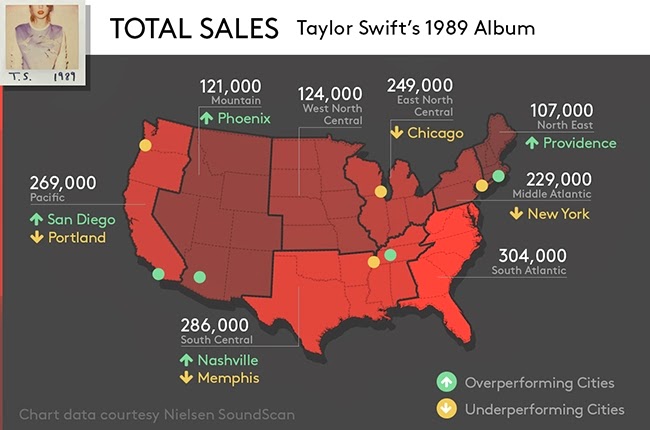
Quote:
Originally posted by FAME.

The North East being the only ones not really here for the mess (as usual)  |
You have to account for the total population of each region tho.
Here's what it would look like if each region maintained the same rate of purchase w/ a population size equal to the most-populated region (which by no coincidence is also the one w/ the highest sales):
| Region | Total Pop. | Actual | % Pop. | Adjusted |
| North East | 14.6m | 107k | 0.73% | 452k |
| West Central | 20.9m | 124k | 0.59% | 367k |
| Middle Atlantic | 41.3m | 229k | 0.55% | 342k |
| Pacific | 49.2m | 269k | 0.55% | 338k |
| East Central | 46.7m | 249k | 0.53% | 330k |
| Mountain | 22.9m | 121k | 0.53% | 327k |
| South Central | 56.6m | 286k | 0.51% | 312k |
| South Atlantic | 61.8m | 304k | 0.49% | 304k |
To me it looks fairly uniform across all regions (taking into account the inverse trend where a larger population presents a greater challenge to maintaining a certain rate) EXCEPT for the North East, which appears to be something of an outlier.
That does at least seem to lend credence to my perception that (surprisingly enough) New England may actually be one of her strongest regions, comparatively speaking, which runs contrary to conventional wisdom on that point.


 no u aren't bitch

 mess i like her tho